



 |
|||
 |
|||
 |
 |
 |
|
 |
| Sections Scouts Main Join Uniform Badges POR |
BBS Scout Handbook
The British Boy Scouts & The British Girl Scouts Association
BBS Scout Badge Guide
BBS Scout Training Scheme
Admission Tests And Proficiency Badges
This Handbook replaces that of the same title in the same series.
Publishing History
First Edition 1933
Second Edition September 1985
Third Edition March 1986
Fourth Edition July 1993
Fifth Edition February 1999
Sixth Edition February 2014
February 2014 ISSN 0267-4068

Uniform
General Conditions
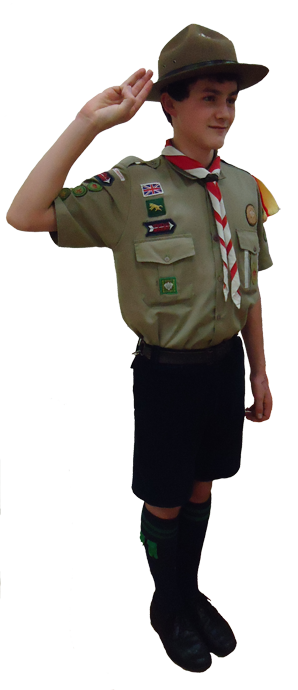
In the description of uniform 'Scout Colours' refers to the traditional colours of Khaki, Navy Blue, Green or Grey.
Scouts: British Boy Scouts (BBS)

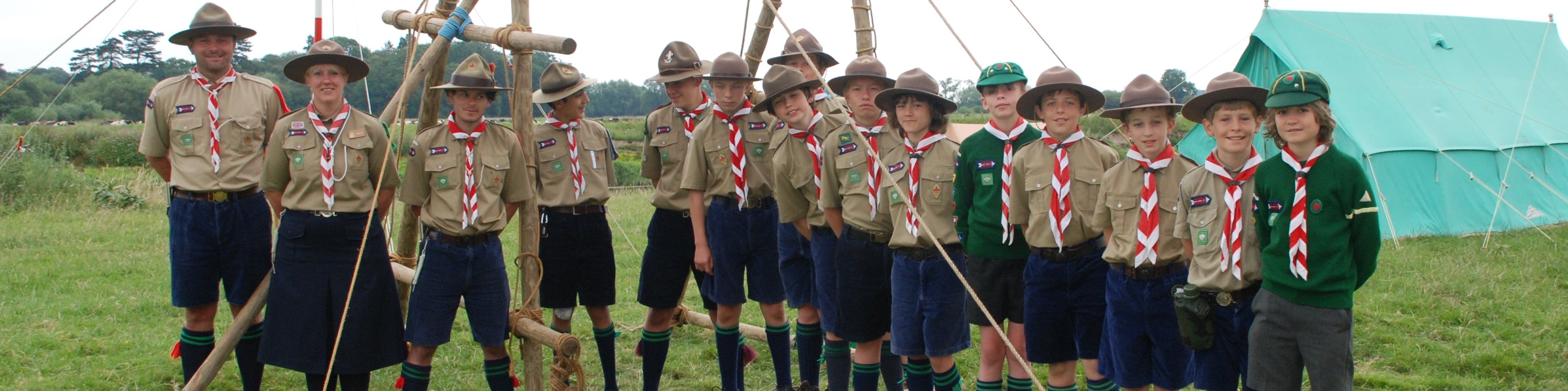
Pictures of the uniform and further information may be found on the uniform page,
- Shirt or Jersey of Scout colour.
- Shorts or Trousers (Scouters/Officers with medical conditions only); of Scout colour.
- Long Socks of Scout colours with two Scout Green (Emerald) rings on the downturns with Scout Green Garter Tabs.
- Headgear - Scout Hat (Khaki) or Beret (Scout Green).
Scouts: British Girl Scouts (BGS)
- Skirt and Shirt or Jersey of Scout colour.
- Skirt or Culottes of Scout colour.
- Lady's Stockings or Tights (Scouters/Officers) of appropriate shade.
- Long Socks (BGS) of Scout colours with two Scout Green (Emerald) rings on the downturns with Scout Green Garter Tabs.
- Headgear - Scout Hat (Khaki) or Beret (Scout Green).
Marine Scouts
As British Boy Scouts and British Girl Scouts with the following variations:
- Headgear (Officers); Dark Blue Cap with black band and white cover.
- Headgear (Scouts); Bluejacket's cap with a white cover and a ribbon inscribed 'Marine Scouts' or similar.
- Shirt or Jersey; Dark blue, Jerseys with the words 'Marine Scout' or similar in white letters across the chest; or shirts with an anchor badge on the right breast.
- White Shirt without badges (but with neckerchief) may be worn other than parade 1st May - 30th September.
- Shorts or Trousers (Officers); Dark Blue.
- Shorts (BBS), Skirts (BGS) on shore, Trousers, when afloat in bad or cold weather; Dark Blue.
Aviation Scouts
As British Boy Scouts and British Girl Scouts with the following variations:
- Shirt or Jersey; Grey or Pale Blue. An Aviation Scout Badge may be worn on the left breast above any service stars or medal ribbons. In place of this Aviation Scout Wings Badge is worn by those qualified as a pilot or equivalent.
- Shorts or Trousers (Officers with medical conditions only); Dark Blue
- Shorts (BBS) Skirts (BGS); Dark Blue
Neckerchief
Scouters/Officers when they are with their Group shall wear the neckerchief of the Scout Group.
When Scouter/Officers are not with their Group or Company they may wear either their Scout Group neckerchief or the 'Order of World Scout' neckerchief for those holding the 'Wood Badge' issued by the 'Order of World Scouts'.
Shoes
Shoes must be of appropriate colour and must be standard within a section selected from black or brown.
Accessories
Appropriate accessories can be worn or carried suitable to any given occasion:
- Scout Staff, carried on suitable occasions.
- Lanyard, to carry a whistle or knife.
- Handaxe, carried on the belt, but only on appropriate occasions.
- Rescue Cord, a 180cm long neatly coiled cord carried on the belt.
- First Aid Kit, a small First Aid kit carried on the belt on appropriate occasions.
- Outdoor Wear, the members of any Section of a Group should be encouraged as far as possible to wear raincoats of the same style and colour; but, if necessary, and overcoat of a plain colour may be worn. Bright colours or loud patterns must not be allowed.
Knives
Sheath Knives, must not be worn in public places, other than at Camp and as part of the Uniform.
Folding Pocket Knives may be carried at any time, provided the blade does not exceed 8cm (3 inches). Pocket Knives with longer blades must not be carried in public places.
Scouts: Badges and Rank Insignia
A Scout wears the following badges:
In Uniform a cloth badge with the letters BBS or BGS superimposed in red on a white arrow with a black ground, worn mid-point between elbow and shoulder of the right sleeve; A cloth badge with a white 'Peace Lily' Fleur-de-lys on a blue background or a 'Red Fluer-de-lys' at the discretion of the Scout Group but must be consistent throughout worn on the left breast of the shirt or blouse.
A Patrol Seconder wears in addition, on the left breast of the shirt or blouse, one stripe of White braid, 15mm wide and 8cm long, on the right hand side of the Fleur-de-lys badge.
A Patrol Leader wears two stripes of White braid as above either side of the Fleur-de-lys badge.
A Troop Leader wears three stripes of White braid, with the third stripe behind the Fleur-de-lys badge.
Training Scheme: Scouts
The General scheme of Scout badges is as follows:
- An admission test (Tenderfoot).
- Two general proficiency badges: Second Class Scout and First Class Scout.
- Special Proficiency badges - for different subjects. Scout badges for those under 15 years of age and Senior Scout badges for those over 15 years of age (Details on badge section). Scouts under 15 may study for the senior badges at any time, but may not be examined for more than two of them until qualified by age.
- Additional proficiency badges based on holding certain badges under (3) above - Grand Scouts Crown, Bushman's Thong, Marine Scout Badge, Aviation Scout Badge and Scout Cord.
- Scouts may not wear proficiency badges gained as Wolf Cubs or when Beavers, with the exception of the Leaping Wolf, which is worn until the Scout gains the First Class Badge.
- A Scout may not gain more than six proficiency badges before gaining the First Class badge. Two of these may be from the list of Senior Scout Badges. (see (3) above).
- A Scout over 15 may continue to wear the badges gained while under that age until the senior equivalent has been gained.


Method of Wearing
Badge positions are shown in detail on the uniform badge position page
Proficiency badges are worn on the right arm in parallel rows between the shoulder and elbow below and above the BBS or BGS membership badge, except as follows:
- The Second Class badge is worn on the left arm between the shoulder and elbow.
- The First Class badge is worn when gained in place of the Second Class.
- Public service badges will be worn on the left arm with the First Aid at the top. The public service badges are as follows (Under 15):
- Air Spotter
- Coxswain
- Cyclist
- Firefighter
- First Aid
- Guide
- Jobman
- Life Saver
- Linguist
- Missioner
- Signaller
- The Scout Cord will be worn round the right shoulder.
- If any Ambulance Association's First Aid badge has been gained, this may be worn instead of the First Aid badge or Ambulance Badge and is worn uppermost on the left shoulder.
- Swimming badges or Life Saving badges may be worn on the right sleeve just above the elbow. Only one badge may be worn, usually the highest award.
Scout Admission Test: Tenderfoot
Before being invested, the Candidate must be told something about the founding of the Scout Movement by, and the life of, Baden-Powell and the history of the BBS. The Scout must satisfy the SM in the following tests:
- Know the Scout Promise/Pledge and Scout Law, and their meaning in accordance with his/her age.
- The Scout Salute.
- Know the composition of the Union Flag, and how to hoist, break and fly it.
- Clean a wound, and make and apply a dressing.
- Make the woodcraft signs given in the BBS Scout badge Guide Book or 'Scouting for Boys' camp Fire Yarn 4.
- Demonstrate with rope how to tie the following: reef knot, sheet-bend, clove hitch, bowline, round turn and two half hitches, sheepshank; and explain their uses.
- Whip the end of a rope.
Second Class
Before awarding the Second Class badge the Scout must pass the following tests:
-
- Show how to deal with the following common minor accidents:- Cuts and scratches, bleeding from the nose, stings and bites, burns and scalds.
- Know how to avoid sun-burning. Demonstrate the use of the triangular bandage as a sling. Demonstrate how to summon help and to treat for shock (not electrical).
- Know the general rules of health as given in camp fire yarn 18 of 'Scouting for Boys'.
- Kim's Game. Describe in writing 16 out of 24 well assorted articles following one minutes' observation, or follow a trail half-a-mile (800m) long containing not less than 30 woodcraft signs, in 25 minutes.
- Be able to recognise and name, from a list submitted by the Scout, six common trees, and know the value of their woods for fires.
- Tie the following and know their uses: timber-hitch and fisherman's knot.
- Demonstrate square and diagonal lashings by constructing a trestle of Scout staffs.
- Know the safety rules and care of a hand-axe and knife. Demonstrate how to chop firewood.
- Know the 16 points of the compass and how to set a map.
- Lay and light a fire out-of-doors with natural materials, using not more than two matches; cook over this fire, a sausage and potatoes, and a twist or damper, and make tea.
-
- Show that he/she understands the Highway Code, Paragraphs on the road user on foot and paragraphs on the road user on wheels.
- If he/she has the use of a bicycle, demonstrate that he/she is keeping it properly maintained and that he/she is able to effect minor repairs.
- Go by day, on foot, with other Scouts, at least one of whom must be another Tenderfoot Scout, a journey of 8 miles (13km). The journey will have a route laid down by the Scout Master and an objective will be given. A verbal report, from notes will be made to the Scout Master by the Scout immediately he/she returns. The following regulations will be observed:
- Homebase. There must be a homebase, to which the Scout can make telephone contact during the journey, and a journey Supervisor appointed, who must be in the vicinity of the journey, to ensure the safety of the Group.
- Numbers. A minimum of 3 Scouts and a maximum of 7 Scouts, must undertake the journey. It is not necessary for all the group to be under assessment, but all must be properly equipped and be capable of undertaking the journey. If both Tenderfoot Scouts are taking the test, each will report independently.
- Have not less than three months' service as a Scout and a good attendance at Church.
- Re-pass the Tenderfoot test. This test will be taken last.
Before being awarded the Second Class badge, the Scout Master will ensure that the Scout understands the Scout Promise/Pledge and Scout Law in accordance with the Scouts age and development, and is a satisfactory member of his/her patrol.
First Class
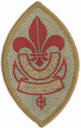
Before being awarded the First Class badge, a Second Class Scout must pass the following tests:
- Have camped, as a Scout, for a total of 10 nights before completing his/her first class tests. One weekend camp, at least, must be included in the total.
- Demonstrate the proper method of dealing with the following emergencies: fire, drowning, ice-breaking and electric shock.
- Know the position of the main arteries and how to stop external bleeding from veins and arteries. Demonstrate how to deal with a fracture of the collar bone.
- Understand the importance of immobilising a fracture limb and the importance of not moving other suspected fractures. Demonstrate the use of the Triangular bandage as applied to the knee, head, and foot. Demonstrate how to deal with shock.
Note: A Scout who has gained the First Aid Badge will be deemed to have passed this test. - Swim 50 metres (50 yards) unassisted any style. If a Doctor certifies that bathing is dangerous to a person's health, the latter must, instead of this, pass one of the other badges: For Scouts under 15, Camper, Jobman, Woodcraftsman, Backwoodsman, Stalker or Starman.For Scouts over 15, Camp Warden, Handyman, Naturalist, Senior Pioneer, Tracker or Astronomer. The S.M. may allow a Scout to gain the First Class badge without passing the swimming test, provided he is satisfied that it is not practicable for the Scout to obtain facilities for learning to swim, and that the Scout gains the alternative badge as in the case of those holding a doctor's certificate. The Scout should make every effort to pass the swimming test as soon as possible.
- Read the meaning of a series of simple tracks made in sandy or other suitable ground. These should include running, limping, carry a weight, walking backwards, and blind gaits.
- Be able to recognise and name, from lists submitted by the Scout, 12 common trees and 6 common birds.
- Using improvised apparatus, such as a Scout staff, estimate three distances not more than half-a-mile (800m), and three heights not more than 30m (100 feet). In each case the estimate to be within ten per cent error above or below the actual.
- Demonstrate the following: sheerlashing, back and eyesplice, fireman's chair knot, manharness knot, rolling hitch.
- Use a felling axe for felling or trimming light timber, or, if this is impracticable, be able to log up a piece of timber and demonstrate the theory of felling a tree, and use a bush or cross-cut saw. Demonstrate the care and maintenance of an axe.
- Read and be able to use a 1:50,000 Ordnance Survey map (or its local equivalent). Use a compass. Point out a compass direction by day or night without the aid of a compass.
- Re-pass the Second Class badge tests 1-10 inclusive. This test will be taken next to last.
- Go on foot, with another Scout or up to two other Scouts, a 24 hour journey of at least 14 miles (22.5km). In the course of the journey the Scouts must cook their own meals, one of which must include meat, over a wood fire in the open; find their camp site and camp for the night. The Scouts must carry out any instructions given by the Assessor as to things to be observed en route and those under Assessment make a log of their journey sufficient to show they have carried out those instructions.
The Scouts may do this journey partly by water and partly be land - at least 5 miles (8km) of the 14 to be done on foot.
This test will be taken last, and the following regulations will be observed- (a) Equipment. Clothing, footwear and equipment should be suitable for the activity and the environment in which it is to be used and generally conforms to current accepted practice. The equipment must be capable of resisting the worst weather for, in the event of a serious deterioration in conditions, safety may well depend on it being able to withstand the prevailing conditions.
- (b) Personal Emergency Equipment. The following equipment must be carried; Map(s), Compass, Watch, Torch, First Aid Kit, Whistle, Coins for the telephone, Notebook and pencil, Spare Pullover and a Waterproof Jacket or Coat. If the Journey is in Wild Country, the following additions must be carried; A Bivvy/Survival Bag, Matches, Emergency rations, Extra Warm Clothing, Spare bulb and batteries for the torch. The weight of personal gear carried by members of the group must not exceed one quarter of their body weight.
- (c) Training and Practice Journeys. Training in safety procedures, First Aid, navigation, campcraft, country code, observation and recording must take place in addition to the skills required by the method of journeying and the environment in which the venture is taking place. Prior to the qualifying venture, all participants are required to carry out practice journeys which may be accompanied by adults. These do not need to be of the same duration, or in the same area of the venture, but the conditions need to be similar. Practice Journeys should include one or more nights of camping.
- (d) Homebase. There must be a homebase, to which the Scouts can make telephone contact during the journey, and a journey Supervisor appointed, who must be in the vicinity of the journey, to ensure the safety of the Group. The Supervisor should make daily contact with the Group.
- (e) Numbers. A minimum of 2 Scouts and a maximum of 3 Scouts, must undertake the journey. It is not necessary for all the group to be under assessment, but all must be properly equipped and be capable of undertaking the journey. Each Scout taking the test, will report independently.
- (f) Planning. This should be a well thought out and carefully planned activity approved by the Scouter/ Officer. A Route Card for each day must be filled in, containing distances, timings, check points, and in wild country, alternative bad weather routes and escape routes for each leg (i.e. civilisation, or a road, or regular footpath). A copy of the Route Card, along with a tracing of the route, on good quality tracing paper, or marked on a photocopy of the map being used, this must be supplied to both the homebase and to the Journey Supervisor. The Route Card and Map Tracing will enable any rescue team to locate the group quickly if any emergency occurs.
The Scout Cord
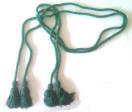
A braided lanyard in Scout green, worn over the right shoulder.
Before being awarded the Scout Cord, a Scout must:
Hold the First Class Badge and six proficiency badges, one of which must be selected from; Backwoodsman, Explorer and Pioneer and one from Camper, Cook, Stalker, Starman, Weatherman, Woodcraftsman.
The Scout Cord will be worn wear it until such time as the Scout gains the Bushman's thong.
Proficiency Badges
The following Proficiency Badges may be earned by Scouts:
Air Apprentice; Air Glider; Aircraft Spotter N2; Aircraft Modeller; Angler; Athlete; Backwoodsman; Bandsman; Basket Maker; Bellringer; Boatswain's Mate; Bookbinder; Camper; Canoeist; Cook; Coxswain N2; Cyclist N2; Designer; Explorer; Firefighter N2; First Aid N2; Gardener; Guide N2; Helmsman; Jobman N2; Joiner; Leather Worker; Lifesaver N2; Linquist N2; Marksman; Master-at-arms; Metal Worker; Missioner N2; Music Maker; Oarsman; Observer; Photographer; Pioneer; Piper; Printer; Reader; Rider; Rope Spinner; Scribe; Signaller; Small Holder; Speaker; Sportsman; Stalker; Stamp Collector; Starman; Swimmer; Weatherman; Wirelessman; and Woodcraftmans.
More information on Proficiency Badges may be found here
Proficiency badges marked thus N2 are public service badges.
Syllabi for all the above badges are available on request from GHQ.
The Ki-Ro Badges
Information about the Ki-Ro badge may be found here
The Ki-Ro Badge


Appendix A Scout Patrol Names and Colours
Each Patrol is identified by a Patrol name. A Shoulder Knot of identifying colours is worn by each member of the Patrol. The Patrol Knot consists of two pieces of braid 2.5cm wide, 27cm in length, laid together and folded in half. The Knot is attached at the fold to the left shoulder at the beginning of the epaulette. The first colour stated in the Patrol name list is the outer colour, the second colour being the inner colour. Where a single colour is stated, both pieces of braid are of that colour. The list of permitted Patrol names is given below.
- Alligator: Green and Khaki
- Antelope: Navy Blue and White
- Badger: Mauve and White
- Bantam N3 N5: Dark Buff (BBS Patrol not in BSA List)
- Bat: Light Blue and Black
- Bear N4: Brown and Black
- Beaver: Blue and Yellow
- Bison N5: Dark Brown
- Bittern: Grey and Green
- Blackbird: Black and Khaki
- Buffalo: Red and White
- Bull N1 N2: Red (Brownsea-Green)
- Bulldog: Light Blue and Brown
- Camel N5: Khaki and Brown
- Capercaillie: Brown and Grey
- Cat: Grey and Brown
- Cheetah N5: Orange and White
- Chough: Black and Red
- Cobra: Orange and Black
- Cockerel: Red and Brown
- Cormorant: Black and Grey
- Corncrake: Purple and Grey
- Crow N3: Black and Orange (BBS 1909 Black)
- Cuckoo N2 N3 N4: Grey (BBS 1909 Dark Red)
- Curlew N1 N2: Green (Brownsea-Yellow)
- Dove: Grey and White
- Eagle N4: Green and Black
- Elephant: Purple and White
- Elk N5: Grey
- Falcon: Red and Orange
- Fox: Yellow and Green
- Gannett: Yellow and Navy Blue
- Garganey: Brown and Green
- Giraffe N5: Yellow and Brown
- Golden Plover: Orange and Grey
- Grouse: Dark and Light Brown
- Hawk: Pink
- Hedgehog N5: Black
- Heron: Green and Grey
- Hippo: Pink and Black
- Horse: Black and White
- Hound N2 N3 N4: Orange (BBS 1909 Dark Brown)
- Hyena: Yellow and White
- Jackal: Grey and Black
- Jaguar: Orange and Brown
- Kangaroo N2: Red and Grey
- Kestrel: Royal Blue and Green
- Kingfisher: Kingfisher Blue
- Leopard N5: White and Yellow
- Lion N2 N4: Yellow and Red
- Merlin: Royal Blue and Maroon
- Mongoose: Brown and Orange
- Nightjar: Black and Buff
- Otter N3 N4: Brown and White (BBS 1909 Dark Blue)
- Owl N2: Blue
- Panther: Yellow
- Peacock N3 N4: Green and Blue (BBS 1909 Dark Mauve)
- Peewit N2 N3 N4: Green and White (BBS 1909 Dark Green)
- Penguin: White and Orange
- Pheasant: Brown and Yellow
- Pochard: Chestnut Brown and Grey
- Puffin: Grey and Yellow
- Rabbit N5: Pink and Brown
- Ram N2: Brown
- Rattlesnake: Pink and White
- Raven N1 N2: Black (Brownsea-Red)
- Rhino: Navy Blue and Orange
- Sea-Gull: Light Blue and Scarlet
- Seal: Red and Black
- Sheep N3 N5: Dark Grey (BBS Patrol not in BSA List)
- Skua: Royal Blue and Brown
- Snipe: Royal Blue and Scarlet
- Springbok: Scarlet and Yellow
- Squirrel: Grey and Dark Red
- Stag: Violet and Black
- Starling: Black and Yellow
- Stonechat: Chestnut and Black
- Stork: Blue and White
- Stormy Petrel: Navy Blue and Grey
- Swan: Grey and Scarlet
- Swift: Navy Blue
- Tiger N4: Violet
- Walrus: White and Brown
- Widgeon: Khaki
- Wild Boar: Grey and Pink
- Wolf N1 N2: Yellow and Black (Brownsea-Blue, 1908 Yellow)
- Woodcock: Chestnut Brown and Mauve
- Woodpecker: Green and Purple
- Wood Pigeon: N2 N4 Blue and Grey
- Zebra N5: White and Black
45 'beasts' (including snakes & bat) 45 'birds' 90 Patrols in all.
N1 Original Patrols of the Brownsea Island Camp of 1907.
N2 Original list of Patrols in Scouting for Boys 1908.
N3 Original Patrols of the 1909 BBS Manual.
N4 Boys Life Brigade Patrols 1916
N5 Unique BBS & BGS Patrols.
Ceremonies
Please click here for more information
General Policy and Regulations Applicable To Scouts
Registration
A Scout Troop must form part of a BBS Scout Group, and the Scout Group must register the Scout Troop under their Scout Group Registration, as for all Sections. The Scout Troop Scouters/Officers must apply for the appropriate warrant for their rank, the forms for which are available from the Group Scout Master or from the BBS Headquarters. Please note that a Scout Troop may be permitted to be formed in advance of a full Scout Group being established with the approval of the BBS Headquarters.
Child and Young Persons Protection and Safeguarding Policies
The Association's policies and procedure for these are obtainable on request from the BBS Headquarters. All warranted Scouters/Officers will need to complete forms relating to these policies and undergo checks to ensure that the Association policies are being fully complied with.
Insurance
The Scout Group is responsible for their own Public Liability and any Personal Injury insurance that must be in line with the BBS Headquarters' requirements in order to qualify for registration of the Association.
Leadership
The ranks for leaders follow similar to those in the other Sections of the Scout Group and are all warranted posts, in order of rank is the 'Scout Master' (SM) or 'Lady Senior Scout Master' (SM), then the assistants referred to as 'Assistant Scout Master' (ASM) or 'Lady Assistant Senior Scout Master' (ASM).
Scout Troop Scouters'/Officers' Titles
The titles or names for the Scout Scouters/Officers are traditionally taken from Naval Ranking. Therefore the name 'SKIP' must be used for the Scout Master. Names for Assistant Scout Masters and any adult helpers will be left to the discretion of the Section concerned, but the names that can be selected from are - 'BOSUN'; 'ENSIGN'; 'PURSER'; 'GUNNER'; 'STITCHY'; 'CHIPPY'; 'SPARKY'; 'MIDSHIPS' as typical examples.
Leader Training
The training of Scout Troop Scouters/Officers follows the same course as for all other Sections, consisting of a 'Preliminary Training Course' (PTC) that will probably be carried out over a weekend, or two day sessions or maybe several evening sessions. At the end of the course a Certificate will be issued and a two-stranded Turk's Head Woggle will be presented.
After completing the PTC comes the 'Part 1 Correspondence Element' consisting of three Studies, each Study consisting of questions to which you, as the Candidates, will have to find the answers by either reading or in discussion groups with others. Each Study will be checked by a Reader appointed for that purpose and then the next Study can be undertaken. On completion of the Correspondence Element a further Certificate will be issued.
Following this will be the 'Part 2 Practical Residential Course' over a long weekend or several short weekends, in which the practical skills of Scouting will be presented. A further Certificate will be issued on Completion of 'Part 2'.
'Part 3 Probationary Period', a probationary period usually of around three months will then take place, after which a report will be submitted by the Group Scout Master, on the suitability of the candidate in putting into practice what has been learned during the 'Wood Badge Training'.
When a recommendation as to the suitability has been received by the Trainers, a further Certificate will be issued, together with the 'Wood Badge' insignia proper and the 'Order of World Scouts' Wood Badge neckerchief.
Whilst the above is not compulsory, it is hoped that all Scouters/Officers will want to become as proficient as possible and will undertake that training. We can all benefit from an exchange of ideas which is inevitably a product of such training.
General Safety At Meetings and Out and About
Safety in the Troop Meetings - Where there are boisterous games it is necessary to remove out of harm's way all things that are likely to cause injury, e.g. tables and chairs, ropes and other equipment not required for that game and especially sharp or pointed objects. Look out for things likely to lead to accidents.
Safety on the Road - The 'Green Cross Code' is an essential part of our Scouting programme and all Scouts should be made well aware of this and be putting this into practice on all outdoor activities and expeditions. This is particularly important if a Patrol or Troop have a need to cross or walk along a road. Other applicable part of the Highway Code must also be learned and put into practice when appropriate, particularly the sections applicable to pedestrians and cyclist.
First Aid - All Scout Troops should have to immediate hand a comprehensive First Aid Kit. This should contain the normal requirements items for dealing with cuts and scratches, grazes and bruises. In addition a small note book to record any details of injuries sustained and the treatment given and by whom, along with the name of the Scout, the date and time and finally the location. A current edition of the First Aid Manual issued by the British Red Cross or similar authority must be kept in the First Aid Kit.
Any head injury which appears to have concussed the injured person should be dealt with at the nearest hospital.
Wherever possible one of the Scouters/Officers in the Scout Troop should be trained in First Aid and preferably hold a valid STA 'Activity First Aid' and 'Emergency First Aid Ay Work' Certificate, or have attended a First Aid Course offered by the British Red Cross or similar authority to the same level.
On all outings carry a First Aid Kit.
If You Are Not Equipped To Deal With A Specific Incident, Get Someone Who Can.
Meetings
Scout Meetings - should be arranged to suit the age group. Meeting lengths of time are flexible for this Section, but normally they will last approximately two hours, and of course as much as possible within the programme should be arranged for outdoor activities.
Court of Honour - is a body composed of the Scout Troop Scouters/Officers, Patrol Leaders; Patrol Seconders may also be members, but their presence is not desirable in cases concerning discipline. The Scout Troop Scouters/Officers present, should act in an advisory capacity only. The Court of Honour is responsible for guarding the honour of the Scout Troop, for arranging the programme of the Scout Troop activities, and for internal administration. It is one of the methods by which Patrol Leaders are trained. The Court of Honour should be called periodically and also held possibly daily when in camp or other expeditions and activities that are spread over a number of days.
Scout Council - It is advisable that a Scout Council meeting should be held at regular intervals. This is an informal meeting of the Scout Troop Scouters/Officers with any other adults working with the Section, to discuss programmes and activities.
Finance
Membership subscriptions should be levied on the individual Scouts. This should be determined by the Group Scout Master in consultation with the Scout Master and should be a reasonable amount, bearing in mind local conditions and expenses incurred in running the Scout Troop as a part of the Scout Group. The monies must be properly accounted for and banked with the Scout Group Treasurer, and the monies expended at the discretion of the Group Scout Master in consultation with the Scout Master. A float could be issued for the Scout Master's accountable cash purchases for the Scout Troop.
Membership and Age Range
Both Boys and Girls are eligible to join this Section when they have attained the age of 10.5 years. They transfer to the Senior Scouts when they have achieved the age of 15 years.
General Uniform Badges All Sections
BBS and BGS Arrow Badges - Two of these Association badges are worn, one on the right breast of the jersey and one on the right arm at the same height as the breast badge.
Scout Group Nametape - The Scout Group nametape is worn at the top of the right arm shoulder of the jersey, following the shoulder seam around.
Order Of World Scouts Badge - This badge is worn on the right breast of the jersey just below the BBS and BGS Arrow badge. This badge is the badge worn by all members of the international 'Order of World Scouts' (OWS), the international membership badge.
Co-Operation between Sections
The Scout Troop cannot exist in isolation as it is, nor should be, it must be a Section of a Scout Group (unless a new group just forming with Scouts only to start with). There must be contact and interactions with the Beavers, Wolf Cub Pack and the Senior Scout Troop on regular occasions to show a good Scouting example to the younger Sections, as well as knowing other Section Scouters/Officers and members of other Sections that they are members of a family in Scouting. Combined activities are very important and all Scouts should fully support these that may be organised by the Scout Group, such joint activities as parades; hikes; parent and members games; fetes and fund raising; Christmas parties, etc.
Co-Operation with Other Organisations
Joint activities with young persons of comparable ages in other organisations such as the Guides and other associations' Scout Sections, Church youth groups, or competitions with school teams are to be encouraged. As our aim is the promotion of our Scouting and all it stands for, and to be seen taking a useful role in community activities and society, we must therefore participate in outside activities and fully support these activities; and not permit the membership to be lukewarm in their participation of these joint or share activities, thereby letting the Scout Group down.
Church Parades
We are principally a Christian Scout Association as such Church Parades and attendance at one's own Church is an essential element for Scouting, embedded in its Scout Promise/Pledge and Scout Law. Therefore Scouts must be encouraged to fully participate in all the Scout Group Church Parades, particularly the St. George's Day Church Parade where the Scouts re-affirm their Scout Pledge/Promise and Scout Law. Monthly Church Parades are recommended in order to fulfil the important elements within the Scout Pledge/Promise and Scout Law with minimum attendance targets set for members. Scouts should take pride in supporting all Church Parades, the marching, the Hymn singing, the pride in being seen in uniform and carrying their Section flag, thereby reinforcing their part played in the family of Scouting. And of course other young people see them and want to join.
Programmes
The programme of activities should be appropriate to the 10.5 and 15 year olds and for both boys and girls, particularly in mixed meetings. As well as outdoor activities the programme should consist of, amongst other things, games with a purpose to promote character building and self-reliance, a sense of duty to others, fun, sportsmanship and interest in the outdoors. Sample programmes can be obtained from the BBS Headquarters on request.
Note: Scout Troop Progress Charts (A3 Display Charts For Wall Hanging) Can Be Obtained From The BBS Headquarters On Request.
We trust that this handbook will be found of great assistance, any questions or requests for further information, please contact the BBS Headquaters.
Wishing You a Great Scouting Future.
|
Pages and content © 2nd Goring and Streatley Scout Group | Disclaimer and Privacy Policy | Contact Us | Sitemap |